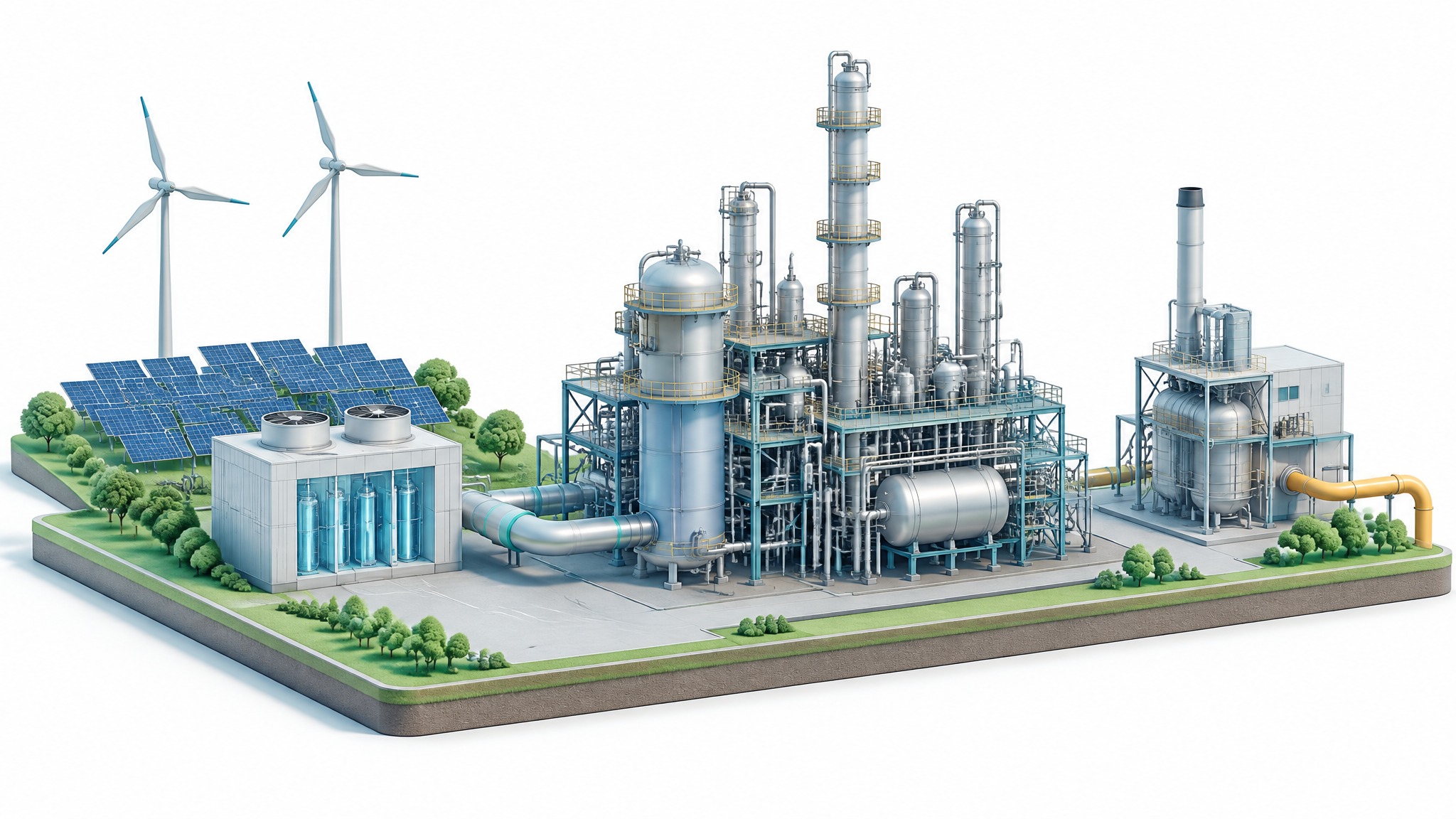
Green hydrogen for refineries is not competitive on price alone today: in our worked example it costs about $6.49/kg against $2.20/kg to keep running an existing gas reformer, a gap of about $4.29/kg. Closing that gap takes policy value worth roughly $485 per tonne of CO2 avoided, or a much cheaper electrolyzer plant and power supply, not a single lever.
Short answer: For a European refinery paying $10/MMBtu for gas and $80/t for CO2, hydrogen from its existing steam methane reformer (SMR) costs about $2.20/kg in cash terms. Green hydrogen from a 100 MW electrolyzer at $45/MWh power and 5,000 full-load hours costs about $6.49/kg. The difference, about $4.29/kg, is what quotas, credits, carbon prices or a buyer premium must cover.
Refining is where most early green hydrogen is being sold. The IEA's Global Hydrogen Review 2026 says "refining and industry remain the main sectors in which low-emissions hydrogen adoption is taking place", and that 2.5 Mt from projects at or past final investment decision is expected to be produced and consumed in refineries and industrial facilities by 2030. This guide shows how a refinery buyer should frame the price question. All figures below are illustrative assumptions unless a source is named.
This is general pre-feasibility guidance, not legal, tax, engineering or investment advice.
What is the real question a refinery buyer is asking?
A refinery already makes or buys hydrogen for hydrotreating and hydrocracking, usually from natural gas. So the question is not "what does green hydrogen cost?" but "what does green hydrogen cost compared with the hydrogen I would otherwise use, and who pays the difference?"
That comparison has a trap. If the reformer already exists, its capital is spent. The cost the refinery actually avoids by switching is mostly gas, carbon and variable operating cost, not the full levelized cost of a new SMR. Comparing green hydrogen with a new-build SMR flatters green hydrogen by a few tens of cents per kilogram.
The second question is volume and shape. A refinery needs hydrogen around the clock, while wind and solar do not deliver it that way. Firming, buffer storage or keeping the SMR as backup all cost money, and our take-or-pay hydrogen offtake guide covers how supply shortfalls are handled in contracts.
What does grey hydrogen from an SMR cost a refinery?
The IEA's Global Hydrogen Review 2026 Assumptions Annex uses these values for unabated gas SMR: capital cost $720/kW of hydrogen output, 76% efficiency (lower heating value), fixed operating cost 5% of capital a year, a 25-year life and 95% availability. The same annex puts 2025 CO2 prices in advanced economies at $0–80/t.
From those values:
- Gas use: hydrogen holds 33.3 kWh/kg (DOE Alternative Fuels Data Center), so at 76% efficiency an SMR burns about 0.158 GJ, or 0.150 MMBtu, of gas per kg.
- CO2: at the IPCC default of 56,100 kg CO2 per TJ of natural gas, that is about 8.85 kg CO2 per kg of hydrogen, before upstream methane emissions.
That intensity is consistent with TotalEnergies' own figure: its 2023 tender for 500,000 t/yr of green hydrogen for six European refineries was expected to avoid "around five million tons of CO2 each year", about 10 kg CO2 per kg.
Green hydrogen for refineries: a worked example
All inputs are illustrative assumptions, not quotes, project data or H2Hub outputs.
Stated assumptions
| Input | Grey (SMR) | Green (electrolysis) |
|---|---|---|
| Capital cost | $720/kW H2 (IEA) | $2,000/kW installed, within IEA's 2025 global range of $1,920–2,500/kW |
| Efficiency | 76% LHV (IEA) | 55 kWh/kg, DOE 2022 status (DOE) |
| Fixed operating cost | 5% of capital a year | 3% of capital a year |
| Running hours | 95% availability | 5,000 full-load hours |
| Energy price | $10/MMBtu gas (Europe case) or $3.50/MMBtu (US case) | $45/MWh power |
| Other | CO2 at $0, $80 or $150/t | Stack replacement $450/kW per 40,000 h; $0.50/kg firming and buffer allowance |
| Finance | 8% over 25 years | 8% over 20 years |
The electrolyzer is 100 MW, which at 5,000 hours makes about 9,091 t of hydrogen a year. The $0.50/kg firming allowance is a placeholder for buffer storage or backup to give the refinery steady supply.
Results per kilogram
| Cost per kg | Existing SMR, Europe ($10 gas, $80 CO2) | New SMR, Europe | Green, 100 MW |
|---|---|---|---|
| Gas or electricity | $1.50 | $1.50 | $2.48 |
| CO2 cost | $0.71 | $0.71 | — |
| Capital recovery | sunk | $0.27 | $2.24 |
| Fixed operating cost | sunk | $0.14 | $0.66 |
| Stack replacement | — | — | $0.62 |
| Firming allowance | — | — | $0.50 |
| Total | $2.20 | $2.62 | $6.49 |
Against the existing reformer, green hydrogen costs $4.29/kg more. For 9,091 t a year, that is about $39.0 million a year that someone must pay.
How much carbon price closes the gap?
With $10/MMBtu gas, the existing SMR would cost as much as green hydrogen only at a carbon price of about $565/t. Put differently, the gap left at $80/t, divided by the 8.85 kg of CO2 avoided per kg, equals about $485 per tonne of CO2 avoided. With US-style gas at $3.50/MMBtu and no carbon price, the existing SMR costs only $0.52/kg and the gap widens to $5.97/kg, or about $675/t.
| Case | Existing grey cost | Green cost | Gap | Gap per t CO2 |
|---|---|---|---|---|
| Europe, $10 gas, $80 CO2 | $2.20 | $6.49 | $4.29 | $485 |
| US, $3.50 gas, no CO2 price | $0.52 | $6.49 | $5.97 | $675 |
| Europe, lower-cost green plant* | $2.20 | $4.51 | $2.31 | $261 |
*$1,440/kW installed (the low end of IEA's 2030 global range), $30/MWh power and 6,000 full-load hours.
Why cheaper power alone cannot close it
In the base case, the green plant's costs other than electricity add up to $4.02/kg. That is already above the $2.20/kg grey cost, so even free electricity would not make green hydrogen competitive here. Capital cost, running hours and stack life matter as much as the power price. Each step moves the result:
- Power at $30/MWh: $5.67/kg; at $60/MWh: $7.32/kg.
- 4,000 full-load hours: $7.22/kg; 6,000 hours: $6.01/kg; 8,000 hours: $5.41/kg.
Our LCOH explainer shows how these cost lines combine.
What policy value can a refinery count on?
The gap is closed in practice by regulation and credits, not by the market price of grey hydrogen. Two rule sets matter most, checked on 26 November 2026.
European Union. The Commission's guidance on RFNBO targets (C/2025/2983, 27 May 2025) says renewable hydrogen (RFNBO) used in refineries to make conventional transport fuels does not count toward the industry target in Article 22a of the Renewable Energy Directive, but toward the transport targets in Article 25. Member States must reach at least a 1% RFNBO share in transport within a combined 5.5% target for RFNBOs and advanced biofuels, and the hydrogen must achieve at least 70% emissions savings. How much that is worth per kilogram depends on each Member State's transposition, so ask for the national quota price or penalty, not an EU average.
That is exactly the business case the EU-funded REFHYNE II project sets out: a 100 MW PEM electrolyzer at Shell's Rheinland site in Germany, which aims to make the economics work by using the hydrogen on site and earning Renewable Energy Directive credits.
United States. The Section 45V clean hydrogen credit applies only to facilities whose construction begins before 1 January 2028 (26 U.S.C. 45V). The credit is a $0.60/kg base, adjusted for inflation, scaled by emissions tier, with 100% of the base only below 0.45 kg CO2e per kg. Refineries considering a US project need to check the deadline, the tier and the wage rules with tax counsel before counting on it.
Contracts. Where policy value falls short, the buyer premium has to be agreed in the offtake contract. Our hydrogen offtake agreement checklist lists the price, volume and certification terms to pin down.
What are refiners actually buying?
- TotalEnergies launched a tender in September 2023 for 500,000 t/yr of green hydrogen by 2030 for six refineries: Antwerp, Leuna, Zeeland, Normandy, Donges and Feyzin (press release). At our example's 9,091 t a year per 100 MW, that volume needs roughly 55 such plants.
- Shell's Holland Hydrogen 1 is a 200 MW electrolyzer built from thyssenkrupp nucera's 20 MW alkaline modules, with a pipeline of about 40 km to Shell's Energy and Chemicals Park Rotterdam.
Neither company has published the price it pays, so these show the scale of demand, not a market price. If the electrolyzer sits away from the refinery, add delivery cost: see our guide to hydrogen transportation cost by pipeline or truck.
What does the example leave out?
- Upstream methane from gas supply, which raises grey hydrogen's true emissions above 8.85 kg.
- Free allocation or other carbon-cost relief a refinery may receive, which lowers the carbon cost it actually pays.
- Oxygen and heat by-products, which some refineries can use.
- Hourly matching rules for certified hydrogen, which can raise firming costs.
- Compression and storage at the refinery gate.
Try it in H2Hub
Start your first H2Hub project free, with no account or card needed, and enter the green-side inputs from this example: a 100 MW electrolyzer, $2,000/kW installed cost and $45/MWh power for your candidate site. Compare the result with your refinery's own grey hydrogen cash cost to see your gap. Your first full project and its PDF report are free (the PDF needs a free sign-in); re-running with new inputs or a second project needs a subscription. The Offtake Lab explains buyer-side terms; Labs are subscriber tools.
Pre-feasibility caveat
These numbers come from stated assumptions, not gas contracts, power offers or vendor quotes. Before negotiating supply, use your refinery's metered SMR gas use and CO2 cost, get electrolyzer and power quotes for the site, and have counsel confirm which quota, credit or tax rules apply in your jurisdiction.
Frequently asked questions
How much hydrogen does a refinery use?
It varies widely with crude slate and units. Ask the refinery for its hydrogen balance in tonnes a day; for scale, TotalEnergies sought 500,000 t a year for six European refineries.
Is green hydrogen cheaper than grey hydrogen?
Not in our example. Green hydrogen cost $6.49/kg against $2.20/kg for an existing reformer in Europe. The gap narrows with cheaper electrolyzers, more running hours, cheaper power and higher carbon prices, but no single change closes it.
What is the CO2 intensity of SMR hydrogen?
Using IEA's 76% efficiency and the IPCC natural gas factor, unabated SMR emits about 8.85 kg CO2 per kg of hydrogen, before upstream emissions. TotalEnergies' tender implies about 10 kg.
Does refinery hydrogen count toward EU renewable targets?
Yes, toward the transport target, according to the Commission's 2025 guidance, when used to make conventional transport fuels and when it meets the RFNBO emissions savings threshold.
Primary sources and further reading
- International Energy Agency — Global Hydrogen Review 2026: Assumptions Annex. SMR and electrolysis cost and efficiency, CO2 prices.
- International Energy Agency — Global Hydrogen Review 2026: Demand.
- IPCC — 2006 Guidelines for National Greenhouse Gas Inventories, Vol. 2, Ch. 1, Table 1.4.
- U.S. Department of Energy, Alternative Fuels Data Center — Fuel Properties Comparison, March 2024.
- U.S. Department of Energy — Technical Targets for PEM Electrolysis, page updated 29 May 2026.
- European Commission — Guidance on the targets for the consumption of RFNBOs in industry and transport, C/2025/2983, 27 May 2025, checked 26 November 2026.
- U.S. Code — 26 U.S.C. 45V, checked 26 November 2026.
- TotalEnergies — Call for tenders for 500,000 tons per year of green hydrogen, 14 September 2023.
- European Commission CORDIS — REFHYNE II: Clean Refinery Hydrogen for Europe II.
- thyssenkrupp nucera — 200 MW green hydrogen facility for Shell in Port of Rotterdam, 10 January 2022.
Editorial verification: 2026-11-26. Worked examples are calculations from stated assumptions, not forecasts, market prices or H2Hub-generated results.