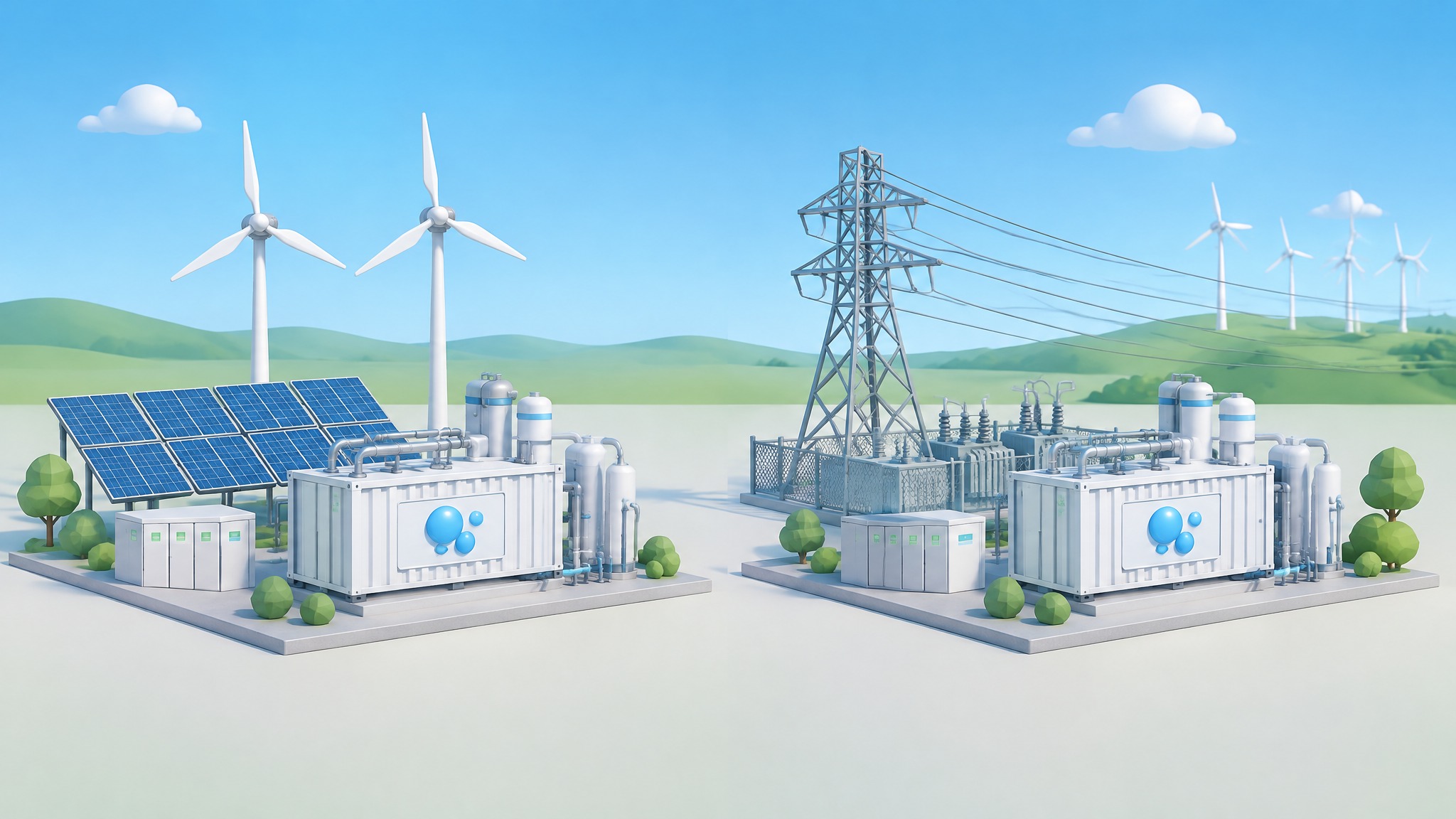
In the grid-connected vs off-grid electrolysis choice, a grid connection can cut the cost per kilogram by letting the electrolyzer run more hours, but the rules decide how much of that hydrogen counts as clean. In the worked 100 MW example below, grid top-up gives the lowest cost at $5.18/kg, yet 45% of its output would fail an hourly renewable-matching test.
Off-grid plants avoid network charges and grid rules entirely, but they run only when their own wind and solar do. Grid-connected plants run longer, pay network charges and must prove where their power came from. This guide sets out the rules in the US and EU as checked on 17 November 2026, then works through the cost trade-off.
Short answer: an off-grid electrolyzer is simpler to certify and avoids grid fees, but sits idle when its renewables do. A grid connection adds hours and reliability, and costs network charges. If certification needs hourly matching, extra grid hours may produce hydrogen you cannot sell as renewable or claim credits on, so the cheapest plant per kilogram is not always the most valuable.
This is general pre-feasibility guidance, not legal, tax, engineering or investment advice.
The real project question
A developer with a site, a renewable resource and a buyer usually faces three options:
- Off-grid (islanded): the electrolyzer takes power only from dedicated wind and solar through a direct line, with no grid connection.
- Grid-connected, matched only: the plant has a grid connection, but runs only when contracted renewable generation is available, so every kilogram is backed by matched renewable power.
- Grid-connected with top-up: the plant also buys grid power when the renewables are not producing, to keep running more hours.
The answer depends on three things: what the grid connection costs per MWh, how many extra hours grid power buys, and whether the hydrogen from those extra hours still qualifies for the credit or certificate your buyer is paying for. Our electrolyzer utilization and hydrogen cost guide explains why extra hours cut cost so sharply.
What the rules say about grid power
United States: Section 45V
The clean hydrogen production credit under Section 45V of the Internal Revenue Code applies only to a facility "the construction of which begins before January 1, 2028," and to hydrogen with lifecycle emissions of no more than 4 kg CO2e per kg (26 U.S.C. 45V). The 2028 date was set by the 2025 reconciliation law, P.L. 119-21; the earlier cutoff was 2033.
The Congressional Research Service summarises the final Treasury regulations of January 2025 (CRS, 30 March 2026). A grid-connected producer can count clean electricity instead of the regional grid average only if three conditions hold:
- Incrementality: the electricity source is generally no more than three years old.
- Deliverability: it is generated in the same region as the hydrogen plant.
- Temporal matching: through 2029, hydrogen and electricity must match within the same year; from 2030, within the same hour.
The full credit of $3.185/kg (2025 value, with wage and apprenticeship requirements met) applies only below 0.45 kg CO2e per kg, so grid-only hours that cannot be matched to clean power are judged on the regional grid's emissions instead.
European Union: RFNBO rules
In the EU, hydrogen counts as a renewable fuel of non-biological origin (RFNBO) under Delegated Regulation (EU) 2023/1184. The text in force, checked on EUR-Lex on 17 November 2026, gives three routes:
- Direct connection (Article 3): the renewable plant is linked by a direct line, came into operation no earlier than 36 months before the electrolyzer, and the electrolyzer either has no grid connection or a smart meter shows it took no grid power.
- Very renewable grids (Article 4(1)): grid power can count as fully renewable where the bidding zone's renewable share exceeded 90% in the previous calendar year.
- Renewable PPAs (Article 4(2)): the producer holds renewable power purchase agreements for at least the amount it claims, and meets temporal and geographic correlation.
Temporal correlation (Article 6) is monthly until 31 December 2029 and hourly from 1 January 2030. Geographic correlation (Article 7) generally means the same bidding zone. Under Article 11, plants that come into operation before 1 January 2028 are exempt from the additionality conditions until 1 January 2038.
The Commission has announced a targeted review of these rules. As of a 21 September 2026 letter from European energy and industry associations, no proposal had been published and the associations asked the Commission to publish it "without further delay" (BDEW-hosted joint letter, an industry association document). Check the current text before relying on any of these dates.
What this means in practice: an off-grid plant with a direct line has the simplest compliance story. A grid-connected plant can qualify, but it needs contracts, metering and matching, and from 2030 both the US and EU rules move to hourly matching. Our guide to hydrogen power purchase agreements covers the contract terms that matter.
Grid-connected vs off-grid electrolysis: a worked 100 MW example
All inputs are illustrative assumptions, not quotes, project data or H2Hub outputs.
Shared assumptions:
- 100 MW electrolyzer using 55 kWh per kg, the DOE 2022 system status value (DOE)
- Installed cost $2,000/kW, within the IEA's 2025 global average range of $1,920–2,500/kW (IEA)
- Fixed operating cost 3% of capital cost a year; 8% discount rate over 20 years (capital recovery factor 0.10185)
- Stack replacement, water, compression and storage are left out to keep the comparison clean
Case assumptions:
| Case | Full-load hours | Power cost |
|---|---|---|
| A. Off-grid, direct line | 4,400 | $35/MWh from dedicated renewables; plus $100/kW for islanded operation (controls, battery, backup supply) |
| B. Grid-connected, matched only | 4,400 | $35/MWh renewable PPA + $15/MWh network and balancing charges |
| C. Grid-connected with top-up | 4,400 + 3,600 | Matched hours as in B; extra hours at $60/MWh grid power + $15/MWh charges |
Results
| Per kg of hydrogen | A. Off-grid | B. Grid, matched only | C. Grid with top-up |
|---|---|---|---|
| Hydrogen per year | 8,000 t | 8,000 t | 14,545 t |
| Average power price | $35.00/MWh | $50.00/MWh | $61.25/MWh |
| Electricity | $1.93 | $2.75 | $3.37 |
| Capital recovery | $2.67 | $2.55 | $1.40 |
| Fixed operating cost | $0.79 | $0.75 | $0.41 |
| Total | $5.39 | $6.05 | $5.18 |
| Output backed by matched renewable power | 100% | 100% | 55% |
Three findings stand out.
Grid top-up is cheapest per kilogram, but only 55% of its output is matched. Case C spreads the electrolyzer's capital cost over 8,000 hours instead of 4,400, cutting capital recovery from $2.55 to $1.40/kg. But the 6,545 tonnes made from grid-only hours are not backed by matched renewable power. Under hourly matching, from 2030 in both the US and EU rules, those tonnes would not qualify as renewable or for the top 45V tier unless the grid itself is very clean.
A grid connection that is used only for matched hours costs more than going off-grid. Case B pays $15/MWh in network charges on every MWh but gets no extra hours. In this example, the connection beats off-grid only if those charges fall below $3.00/MWh, the point where they equal the $100/kW islanding premium.
The grid price moves Case C a lot. If top-up power costs $100/MWh instead of $60, Case C rises to $5.80/kg, more than off-grid. If it costs the same $35/MWh as the PPA, Case C falls to $4.56/kg.
Reading the result
The example shows why "connect to the grid" is not one decision. It is three questions:
- What does the connection cost per MWh, including network tariffs, balancing and any standby fees?
- How many extra hours can you buy, and at what grid price in those hours?
- Will your buyer pay a premium only for certified hydrogen, and does the top-up output qualify?
If the premium for certified hydrogen is large and hourly matching applies, Case C's cheap uncertified tonnes may be worth less than they cost. Sizing more renewables, as in our renewables-to-electrolyzer ratio guide, or adding storage can raise matched hours instead.
What the example leaves out
- Hourly profiles: full-load hours are a simplification. A real plant runs at part load and needs an 8,760-hour dispatch model.
- Minimum load: off-grid plants spend more time near minimum load and on restarts. See our PEM vs alkaline electrolyzer guide for why that matters for technology choice.
- Selling surplus power: a grid connection can export excess renewable power, which off-grid plants must curtail.
- Connection lead time: large grid connections can take years and may require upgrades paid by the project.
- Grid emissions: the 45V tier for grid-only hours depends on the regional emissions rate, which this example does not model.
Try it in H2Hub
Start your first H2Hub project free, with no account or card needed, and enter the inputs from this example: a 100 MW electrolyzer, $2,000/kW installed cost and your site's power price. Your first full project and its PDF report are free (the PDF needs a free sign-in). Re-running the project with a second supply case, such as grid top-up instead of off-grid, needs a subscription. The LCOH Lab explains the cost lines behind each result; Labs are subscriber tools.
Pre-feasibility caveat
These results come from stated assumptions, not network tariffs, quotes or legal advice. Before choosing a configuration, get a grid connection offer, confirm the applicable tariff and charges, and have tax or regulatory counsel confirm how the current 45V regulations or RFNBO rules apply to your project and dates.
Frequently asked questions
Can a grid-connected electrolyzer produce green hydrogen?
Yes, if its electricity is backed by qualifying renewable power. In the EU this means renewable PPAs with temporal and geographic correlation, or a bidding zone above 90% renewable. Under US 45V, it means clean power that meets incrementality, deliverability and temporal matching rules.
What is hourly matching for hydrogen?
Hourly matching requires the electrolyzer's power use in each hour to be covered by renewable or clean generation in that same hour. The EU moves from monthly to hourly matching on 1 January 2030, and the US 45V rules move from annual to hourly matching starting in 2030.
Is off-grid hydrogen cheaper?
Not always. Off-grid plants avoid network charges but run fewer hours, which spreads the electrolyzer's capital cost over less hydrogen. In our example off-grid was cheaper than a matched-only grid connection but more expensive than grid top-up.
Primary sources and further reading
- Congressional Research Service — The Section 45V Clean Hydrogen Production Credit, IF12602, 30 March 2026.
- U.S. Code — 26 U.S.C. 45V, Credit for production of clean hydrogen, checked 17 November 2026.
- European Union — Commission Delegated Regulation (EU) 2023/1184 on RFNBO rules, EUR-Lex, checked 17 November 2026.
- European energy and industry associations — Joint letter on the targeted review of the RFNBO delegated act, 21 September 2026 (industry association document).
- U.S. Department of Energy — Technical Targets for Proton Exchange Membrane Electrolysis, page updated 29 May 2026.
- International Energy Agency — Global Hydrogen Review 2026: Assumptions Annex.
Editorial verification: 2026-11-17. Worked examples are calculations from stated assumptions, not forecasts, market prices or H2Hub-generated results.