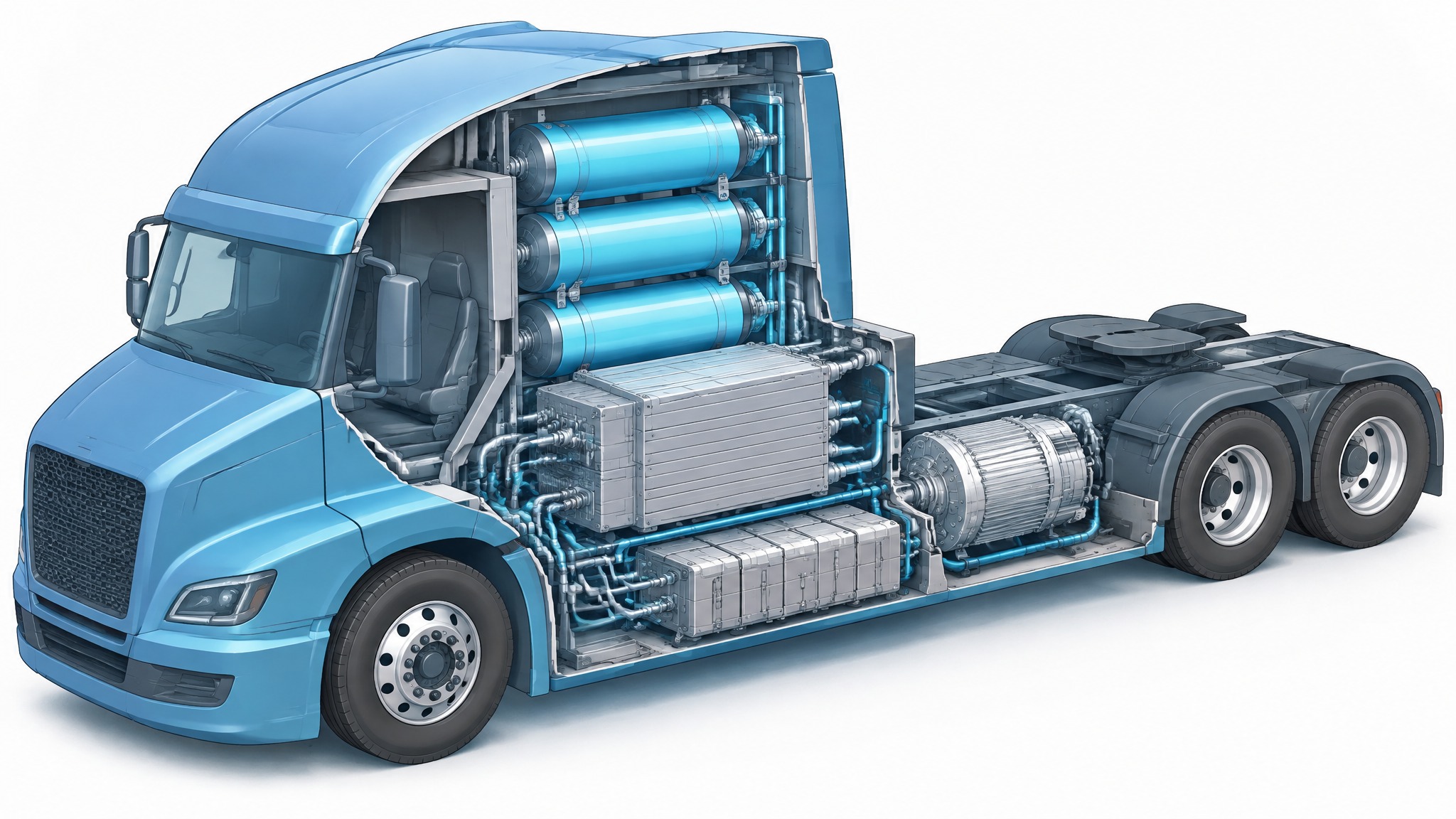
Hydrogen truck cost per mile matches diesel only when dispensed hydrogen costs roughly $3–6 per kilogram, at today's U.S. diesel price. In the worked example below, fuel alone breaks even at about $5.76/kg; once a higher truck price and higher maintenance are counted, the break-even falls to about $4.32/kg.
The quick answer for a fleet or depot buyer: multiply the diesel price per gallon by the truck's miles per kilogram, divide by the diesel truck's miles per gallon, then subtract whatever extra the fuel-cell truck costs to own per mile. What is left is the most you can pay for hydrogen and still break even. This guide works through that calculation with public inputs, shows which assumption moves the answer most, and explains what it means if you plan to buy or produce hydrogen for trucks.
This is pre-feasibility guidance for an industrial offtaker or fleet operator, not a vehicle quote or investment advice.
The real question for a truck fleet buying hydrogen
A fleet manager or logistics company weighing fuel-cell trucks is really asking a supply question: what delivered price of hydrogen can the operation afford, and can anyone supply it at that price near the depot? The truck's sticker price matters, but over hundreds of thousands of miles the fuel price usually decides whether the switch pays.
That makes the break-even hydrogen price the number to negotiate around. It is the ceiling for a supply contract, and the target a hydrogen producer has to beat on the production side.
The documented inputs
Five inputs drive the answer. Here is what public sources say about each.
Diesel price. The U.S. Energy Information Administration's weekly survey put the national average on-highway diesel price at $6.127 per gallon for the week of 9 November 2026, down from $6.352 two weeks earlier. That price includes fuel taxes, so compare it with a hydrogen price that includes any taxes too.
Diesel truck fuel economy. The U.S. Department of Energy's Alternative Fuels Data Center reports average fuel economy of about 6.3 mpg for Class 8 trucks, based on the Federal Highway Administration's Highway Statistics 2024.
Fuel-cell truck fuel economy. DOE's technical targets for hydrogen long-haul trucks (Program Record 19006, 2019) modelled a 2019-status fuel-cell truck at 9.4 miles per kilogram against 10.0 miles per gallon for a comparable modelled diesel truck. Its ultimate 2050 targets are 17.0 mi/kg against 15.6 mpg. Those are drive-cycle models, not fleet measurements, so the useful part is the ratio: a fuel-cell truck covering 0.94 to 1.09 times as many miles per kilogram as the diesel truck covers per gallon.
Maintenance. NREL's total cost of ownership study for Class 8 yard tractors and refuse trucks (2022) assumed operating and maintenance cost of $0.198 per mile for a diesel yard tractor and $0.248 for a fuel-cell one, a 25% markup the authors derived from bus data.
Truck price. No public source gives a reliable current price gap between a production fuel-cell tractor and a diesel one; it depends on the model, volume and incentives. The example below treats it as an assumption and tests three values. DOE's target analysis expects the gap to close entirely if every 2050 target is met, putting a fuel-cell truck at $0.57 per mile in fuel and capital cost against $0.54 for an advanced diesel truck.
The hydrogen truck cost per mile break-even formula
Per mile, a diesel truck spends the diesel price divided by its mpg on fuel. A fuel-cell truck spends the hydrogen price divided by its miles per kilogram. Setting the two equal and allowing for any other cost difference gives:
Break-even hydrogen price ($/kg) = (diesel price ÷ diesel mpg − extra non-fuel cost per mile) × fuel-cell miles per kg
With no extra non-fuel cost, the diesel mpg cancels out and the break-even is simply the diesel price multiplied by the efficiency ratio. At $6.127/gal, that is $5.76/kg at DOE's 2019-status ratio and $6.68/kg at its ultimate ratio.
Worked example: one long-haul tractor
All inputs are illustrative assumptions, not quotes, project data or H2Hub outputs.
Stated assumptions:
- Diesel at $6.127/gal (EIA, week of 9 November 2026).
- Diesel truck at 6.3 mpg (AFDC, Class 8 average), so fuel costs $0.973 per mile.
- Fuel-cell truck at 0.94 times the diesel truck's distance per unit of fuel (DOE 2019-status ratio), or 5.92 mi/kg.
- Extra maintenance of $0.05 per mile (NREL's $0.248 minus $0.198).
- 100,000 miles a year over a 7-year ownership period.
- Extra purchase price of $0, $100,000 or $200,000 for the fuel-cell truck, recovered at 8% a year (capital recovery factor 0.19207).
Results
| Extra truck price | Extra capital cost per mile | Fuel budget per mile | Break-even hydrogen price |
|---|---|---|---|
| $0 | $0.000 | $0.923 | $5.46/kg |
| $100,000 | $0.192 | $0.730 | $4.32/kg |
| $200,000 | $0.384 | $0.538 | $3.19/kg |
The "fuel budget per mile" is the diesel truck's $0.973 fuel cost minus the fuel-cell truck's extra maintenance and capital cost. Multiplying it by 5.92 mi/kg gives the most the fleet can pay for hydrogen.
How far the answer moves
Holding the $100,000 premium, the break-even changes with each input as follows:
| Change | Break-even hydrogen price |
|---|---|
| Diesel at $4.00/gal | $2.33/kg |
| Diesel at $5.00/gal | $3.27/kg |
| Diesel at $6.127/gal (base) | $4.32/kg |
| Diesel at $7.00/gal | $5.14/kg |
| Fuel-cell truck at 5.0 mi/kg | $3.65/kg |
| Fuel-cell truck at 7.0 mi/kg | $5.11/kg |
| Fuel-cell truck at 8.0 mi/kg | $5.84/kg |
Diesel price is the biggest single lever: each $1 per gallon moves the break-even by roughly $0.94/kg in this case. Fuel economy is next. Stop-and-go duty can favour fuel cells strongly; NREL projected fuel-cell yard tractors at roughly three times the fuel economy of diesel ones, which would raise the break-even far above the long-haul figures here.
What it costs to miss the target
At the base case, hydrogen at $8/kg adds about $0.62 per mile over diesel, or about $62,000 a year for one truck at 100,000 miles. At $10/kg the gap is about $0.96 per mile, or $96,000 a year; at $15/kg it is about $1.80 per mile, or $180,000 a year. Across a fleet of 20 trucks, a few dollars per kilogram is the difference between a pilot and a business case.
What this means for the hydrogen supply side
The example's break-even of roughly $3–6/kg is a dispensed price. It has to cover production, compression, storage, delivery and the station, plus any margin. Research by the ICCT, a transport research nonprofit, reached a similar range from another angle: it found U.S. long-haul fuel-cell trucks would need green hydrogen at about $3.00 to $6.50 per kilogram to match battery-electric trucks on total cost of ownership.
So a fleet considering hydrogen should ask two questions before ordering trucks:
- What would hydrogen cost to produce near the depot? The levelized cost of hydrogen at a nearby site sets the floor before any delivery or dispensing cost.
- Can the supply be contracted at a fixed price? A truck fleet's fuel use is predictable, which is valuable to a producer. Our guide to take-or-pay hydrogen offtake terms shows how committed volume changes a supply project's economics, and the hydrogen offtake agreement checklist covers the terms a buyer should pin down.
If the production cost alone at the best available site sits well above the break-even, no supply contract will close the gap without subsidy or a carbon price.
Try it in H2Hub
Take the break-even from this example (about $4.32/kg in the base case) as your target, start a free H2Hub project for a candidate production site near your depot, and compare the project's estimated hydrogen cost with your break-even. If it falls short, note which assumption would have to change, such as the power price, before paying for a closer study.
Your first full project and its PDF report are free; downloading the PDF needs a free sign-in. H2Hub estimates hydrogen production economics. It does not model truck performance, so the truck-side numbers stay in your own calculation.
Pre-feasibility caveat
This calculation leaves out several real costs: refuelling time and route coverage, truck residual value, payload differences, insurance, financing terms, any hydrogen or road fuel taxes, and incentives for vehicles or fuel. Fuel-cell durability in real fleets is less documented than diesel. Use the result to decide whether a closer study is worth doing, then replace every assumption with quotes from truck makers and hydrogen suppliers.
Frequently asked questions
What hydrogen price makes a fuel-cell truck competitive with diesel?
At $6.127/gal diesel, fuel alone breaks even at about $5.76/kg on DOE's 2019-status efficiency ratio. Counting a higher truck price and maintenance, the example's break-even falls to roughly $3.19–5.46/kg, depending on the price gap.
How many miles per kilogram does a hydrogen truck get?
DOE modelled a 2019-status long-haul fuel-cell truck at 9.4 mi/kg on its drive cycle, with a 2050 target of 17.0 mi/kg. Real-world figures depend on load, route and climate, so ask truck makers for data on your duty cycle.
Is a hydrogen truck cheaper to run than a diesel truck?
Only when hydrogen is cheap enough. In the example, hydrogen at $8/kg costs about $0.62 per mile more than diesel once maintenance and a $100,000 price premium are included.
What drives the hydrogen truck cost per mile most?
The hydrogen price and the diesel price it competes with. In the example each $1/gal change in diesel moves the break-even by about $0.94/kg, more than any plausible change in maintenance cost.
Primary sources and further reading
- U.S. Energy Information Administration — Weekly Retail Gasoline and Diesel Prices, U.S. On-Highway Diesel, week of 9 November 2026, checked 14 November 2026.
- U.S. Department of Energy, Alternative Fuels Data Center — Average Fuel Economy by Major Vehicle Category, based on FHWA Highway Statistics 2024, Table VM-1.
- U.S. Department of Energy Hydrogen Program — Record 19006: Hydrogen Class 8 Long-Haul Truck Targets, 31 October 2019.
- National Renewable Energy Laboratory — Powertrain Performance and Total Cost of Ownership Analysis for Class 8 Yard Tractors and Refuse Trucks, NREL/TP-5400-83968, November 2022.
- International Council on Clean Transportation (research nonprofit) — Total cost of ownership of alternative powertrain technologies for Class 8 long-haul trucks in the United States, April 2023.
Editorial verification: 14 November 2026. Worked examples are calculations from stated assumptions, not forecasts, market prices or H2Hub-generated results.