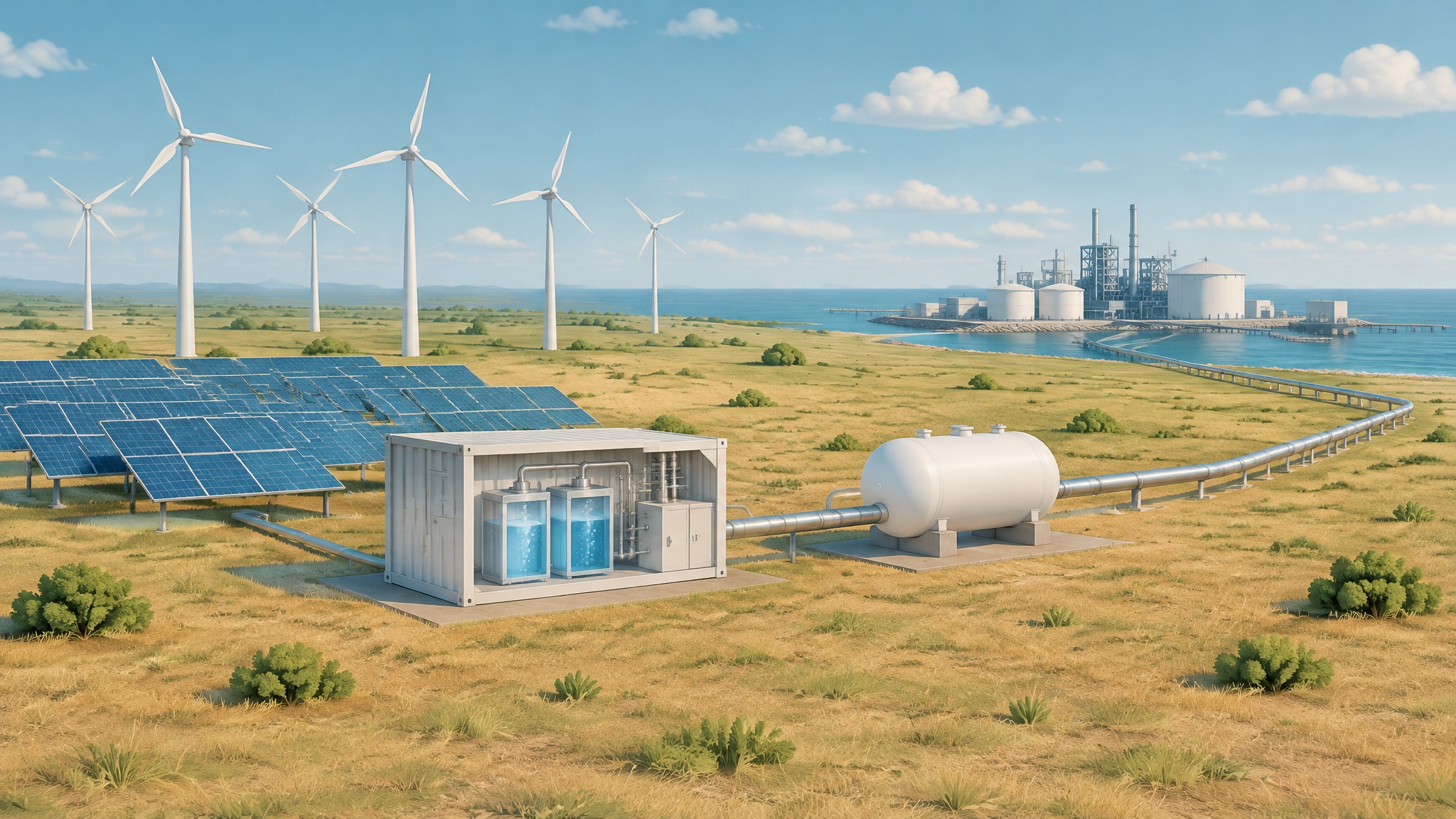
What does green hydrogen cost in Texas? In our worked 100 MW example it ranges from about $4.47/kg to $8.06/kg at the plant gate before incentives, depending mostly on how the electrolyzer gets its power. A hybrid wind and solar supply comes to about $5.14/kg, and the federal 45V credit could lower that by roughly $2/kg in levelized terms, but only for projects that begin construction before January 1, 2028 and meet strict power-sourcing rules.
Short answer: Texas power is cheap and plentiful, but the cost per kilogram depends on operating hours as much as on the electricity price. Round-the-clock grid power gives the lowest pre-credit cost in our example, yet it is the case least likely to earn the full 45V credit. For a developer, the real Texas question is which supply can both run many hours and qualify.
This is general pre-feasibility guidance, not engineering, tax, legal or investment advice. Confirm every figure with power offers, vendor quotes and qualified advisers.
The developer's question: is a Texas site worth a feasibility study?
Texas looks like an obvious hydrogen location. It has large wind and solar fleets, a deep industrial hydrogen market on the Gulf Coast and a competitive wholesale power market. That does not answer whether a particular project can make hydrogen at a price a buyer will pay.
Three things decide the answer: the price of the electricity the electrolyzer actually uses, how many hours a year it runs, and whether the project qualifies for federal support. This article sets out the documented Texas inputs, runs one transparent model across four supply choices, and shows which input to pin down first.
Documented Texas inputs and their uncertainties
Wholesale power prices. The ERCOT Independent Market Monitor's 2024 State of the Market report says real-time energy cost fell 51% to $31.91/MWh of load in 2024, with natural gas at $1.90/MMBtu. Its overview of the 2025 report (August 2026) puts 2025 gas at $3.06/MMBtu and says the all-in electricity price rose 13.8%. Treat 2024's low average as a floor, not a planning price, and remember that an electrolyzer also pays delivery and other charges on top of energy.
Wind and solar output. The U.S. Energy Information Administration reported in October 2025 that ERCOT's utility-scale solar generated 45 TWh and wind 87 TWh in the first nine months of 2025, together meeting 36% of ERCOT demand. Natural gas still supplied 43%, which matters for the emissions of grid power.
Renewable cost and hours. The IEA Global Hydrogen Review 2026 assumptions annex lists 2025 North America costs for good resource conditions of $37/MWh for solar PV at 2,480 full-load hours and $36/MWh for onshore wind at 3,640 hours. These are regional figures, not Texas quotes.
Electrolyzer cost and performance. The same annex puts the 2025 installed cost of water electrolysis at $1,920–2,500/kW as a global average, including electrical equipment, gas treatment, balance of plant and EPC, with fixed operating cost of 3% of capital a year. The U.S. Department of Energy's PEM electrolysis targets give a 2022 system status of 55 kWh/kg.
The 45V credit (checked 15 November 2026). The Congressional Research Service's In Focus on Section 45V, updated 30 March 2026, says that after P.L. 119-21 facilities must begin construction before January 1, 2028, and credits run for 10 years after a facility is placed in service. The top tier is $3.185/kg (2025 value, inflation-adjusted) for lifecycle emissions below 0.45 kg CO2e per kg, if prevailing wage and apprenticeship rules are met; otherwise the credit is cut by four-fifths. Electricity is attributed through incrementality, deliverability and temporal matching, with annual matching through 2029 and hourly matching from 2030.
Worked example: four ways to power a 100 MW plant in Texas
All inputs are illustrative assumptions, not quotes, project data or H2Hub outputs. The model is the same simplified one used in our video, so the two can be compared.
Shared assumptions:
- 100 MW electrolyzer at $2,000/kW installed (inside the IEA global range), $200 million in total
- 55 kWh/kg system electricity use (DOE 2022 status)
- Fixed operating cost 3% of capital a year (IEA annex)
- Water allowance $0.03/kg and stack replacement allowance $0.15/kg
- 8% real discount rate over 20 years, a capital recovery factor of 0.10185
- No incentives, oxygen sales, compression, storage or delivery
Supply cases:
- A. Solar only: 2,480 full-load hours at $37/MWh (IEA North America solar)
- B. Wind only: 3,640 hours at $36/MWh (IEA North America onshore wind)
- C. Oversized wind and solar hybrid: 5,256 hours (60%) at $40/MWh, with the extra renewable capacity priced into the power
- D. Grid supply: 8,000 hours at $45/MWh all-in, an illustrative figure above the 2024 ERCOT real-time energy cost to allow for delivery charges and higher 2025 gas prices
| Result | A. Solar | B. Wind | C. Hybrid | D. Grid |
|---|---|---|---|---|
| Hydrogen per year | ~4,509 t | ~6,618 t | ~9,556 t | ~14,545 t |
| Capital recovery | $4.52 | $3.08 | $2.13 | $1.40 |
| Fixed operating cost | $1.33 | $0.91 | $0.63 | $0.41 |
| Electricity | $2.04 | $1.98 | $2.20 | $2.48 |
| Water and stack allowances | $0.18 | $0.18 | $0.18 | $0.18 |
| Cost per kg, before incentives | $8.06 | $6.14 | $5.14 | $4.47 |
The pattern is the main finding. Electricity costs about $2/kg in every case, so the spread comes from fixed costs shared over very different outputs. Solar alone is cheap power but runs the plant only 2,480 hours, which leaves capital recovery at $4.52/kg. Our comparison of solar vs wind for green hydrogen and our guide to the renewables-to-electrolyzer ratio show how combining and oversizing supply raises those hours.
What 45V does to the ranking
A 10-year credit on a 20-year project is worth less per kilogram than its face value. Discounted at 8%, the $3.185/kg top tier spread over the project's life is worth about $2.18/kg in levelized terms. If the hybrid case qualified, its net cost would fall to about $2.96/kg.
The grid case is cheaper before incentives, but with gas still supplying 43% of ERCOT's demand in early 2025, average grid power is unlikely to meet the top tier's emissions limit without qualifying clean-power attributes. To match the hybrid's net $2.96/kg with no credit at all, the grid case would need all-in power at about $17.60/MWh, well below the 2024 real-time average. In this example, the credit decides the ranking.
How sensitive is the hybrid case?
| Hybrid power price | $20 | $30 | $40 | $50 | $60 |
|---|---|---|---|---|---|
| Cost per kg, before incentives | $4.04 | $4.59 | $5.14 | $5.69 | $6.24 |
Installed cost matters as much. At $1,500/kW the hybrid case falls to $4.45/kg, the figure in our video; at $2,500/kW it rises to $5.83/kg. Our electrolyzer cost per kW guide explains why that number must be a full installed scope.
Watch the ReneEnergy video: What Does Green Hydrogen Cost in Texas? We Ran the Numbers
What this example leaves out
- Hourly dispatch. Full-load hours are assumed, not simulated. Minimum load, curtailment and price spikes need an hourly model.
- Delivery. Plant-gate cost ignores compression, storage and transport to a Gulf Coast buyer.
- Tax-credit detail. Lifecycle emissions, wage rules, credit transfer and the construction-start test need tax advice for your project.
- Price risk. ERCOT prices vary by hour, location and year; a fixed-price PPA and a merchant supply carry very different risk.
The method for testing these ranges is in our LCOH sensitivity analysis guide, and the cost lines are explained in our hub article on what LCOH is.
Try it in H2Hub
You can start a project in H2Hub for free, without an account or a card, for a Texas site you are screening. Enter this article's hybrid case as your starting point: 100 MW, $2,000/kW installed, 60% utilization, $40/MWh power and 55 kWh/kg, then change one number to match your own power offer.
Your first full project and its PDF report are free; downloading the PDF needs a free sign-in. Re-running with new inputs or starting a second project requires a subscription, so choose your strongest base case first. The LCOH Lab is a subscriber tool for working through cost inputs in more depth.
A note on pre-feasibility
These are calculations from stated assumptions. They are not forecasts, Texas market prices or H2Hub-generated results, and they do not replace a feasibility study, power offers or tax advice.
Frequently asked questions
How much does green hydrogen cost in Texas?
In our illustrative 100 MW example, plant-gate cost before incentives ranges from about $4.47/kg on round-the-clock grid power to $8.06/kg on solar alone. A hybrid wind and solar supply comes to about $5.14/kg. Real projects need site-specific power prices and quotes.
Does the 45V hydrogen credit still apply?
According to the Congressional Research Service, facilities must begin construction before January 1, 2028, and the credit runs for 10 years after a facility is placed in service. Check the current rules with a tax adviser on the date you decide.
Is grid power in Texas cheap enough for hydrogen?
ERCOT's real-time energy cost averaged $31.91/MWh of load in 2024. Running many hours on grid power lowers the cost per kilogram, but average grid power is unlikely to qualify for the top 45V tier without clean-power attributes that meet the matching rules.
Why is solar-only hydrogen so expensive?
Because the electrolyzer runs only when the sun shines, about 2,480 full-load hours in the IEA's North America case. The plant's fixed costs are spread over fewer kilograms, which outweighs the cheap power.
Primary sources and further reading
- Congressional Research Service — The Section 45V Clean Hydrogen Production Credit (IF12602), updated 30 March 2026. Credit tiers, construction-start deadline, credit period and power-sourcing rules.
- ERCOT Independent Market Monitor (Potomac Economics) — 2024 State of the Market Report, June 2025. Real-time energy cost and gas price.
- ERCOT Independent Market Monitor — Overview of 2025 State of the Market Report, August 2026. 2025 gas price and all-in price change.
- U.S. Energy Information Administration — ERCOT increasingly meets rising demand with solar, wind, and batteries, 24 October 2025.
- International Energy Agency — Global Hydrogen Review 2026: Assumptions Annex. Electrolysis cost, operating cost, renewable costs and full-load hours.
- U.S. Department of Energy — Technical Targets for Proton Exchange Membrane Electrolysis, page updated 29 May 2026.
- ReneEnergy — What Does Green Hydrogen Cost in Texas? We Ran the Numbers (video).
Editorial verification: 2026-11-15. Worked examples are calculations from stated assumptions, not forecasts, market prices or H2Hub-generated results.